Staining, Laminating or Painting Birch Faces
A birch face is forgiving across all three finish routes, and the choice is usually made on appearance rather than on the panel. The published surface is a uniform birch veneer in light cream to pale brown with thickness running from 2.7 mm to 30 mm, and the page lists staining, laminating and painting as the intended uses — which means the preparation, not the board, decides how the finished face looks.

Key takeaways
- A uniform birch veneer face in light cream to pale brown is published as suitable for staining, laminating or painting.
- Thickness runs from 2.7 mm to 30 mm in 1250 × 2500 mm — 1500 × 3000 mm plus 1220 × 2440 as standard mm formats.
- A 1250 × 2500 mm sheet presents 3.125 m² per face, or 6.25 m² of veneer surface when both sides are finished.
- E1, CARB P2 and CE documentation sit behind the interior range, pressed with low-emission glue systems.
Three finishes, three different preparations
Staining exposes the face, laminating covers it and painting replaces it, and each route places a different demand on the panel. A stain leaves every sanding mark and every change of grain direction on show, so the preparation has to be even across the whole sheet rather than careful only where the light falls. A laminate hides the veneer completely, which shifts the critical work onto the adhesive bond and the flatness of the panel behind it.
Paint sits between the two. An opaque finish covers colour variation, so a lower face grade becomes viable, but it also telegraphs anything underneath: a filled patch, a proud edge, a seam where two sheets meet. Deciding the finish before the panels are ordered is therefore worth more than deciding it after the first sample door has been sprayed, and a Birch Plywood Supplier who publishes the face appearance and the core build on the same page makes that early decision checkable rather than a matter of opinion.
What a birch veneer face offers the finisher
The published face is a birch veneer in light cream to pale brown with a uniform structure, and uniformity is the quality a finisher is buying. A pale, even face takes a light stain and holds a clear sealer without the blotching that appears when the grain density changes across a sheet. It is also why birch shows up in interior joinery, panelling and instrument making, where a face is expected to look the same in the morning light as it did in the sample room.
Machining behaviour matters as much as colour. The panel is published with a multi-layer hardwood core, resistance to warping during machining, plus a build engineered as standard for cutting, CNC machining, sanding plus edge processing with minimal tear-out. Tear-out is the enemy of a finish, because a torn edge or a chipped face veneer cannot be hidden by stain, paint or a laminate that stops short of the edge.
| Finish route | What the published face gives it | The risk to control |
|---|---|---|
| Clear sealer | Uniform pale face that keeps its colour | Sanding marks stay visible under a clear coat |
| Stain plus topcoat | Veneer described as suited to staining | Uneven absorption where the face has been patched |
| Opaque paint | Smooth surface that takes a primer | Seams and edge banding show through a gloss finish |
| Laminate or HPL | Face listed for laminating over a stable core | Bond failures on dusty or damp faces |
Laminate work is a bonding job, not a finishing job
Once a laminate goes on, the veneer stops mattering and the bond takes over. Two conditions decide whether it holds: the face has to be flat, and it has to be dry. A panel with a stable multi-layer hardwood core is easier on both counts, which is why core quality is worth checking before a laminate programme is quoted rather than after the first lifting corner appears in a showroom.
Edge treatment follows the same logic. A laminate wrapped over a machined edge needs a clean, tear-free profile, and that is exactly what the published machining characteristics describe — a build engineered so that cutting and edge processing leave the veneer intact. On thinner panels the edge becomes the weak point, and a solid lipping rather than a taped edge is often the difference between a finish that lasts and one that lifts.
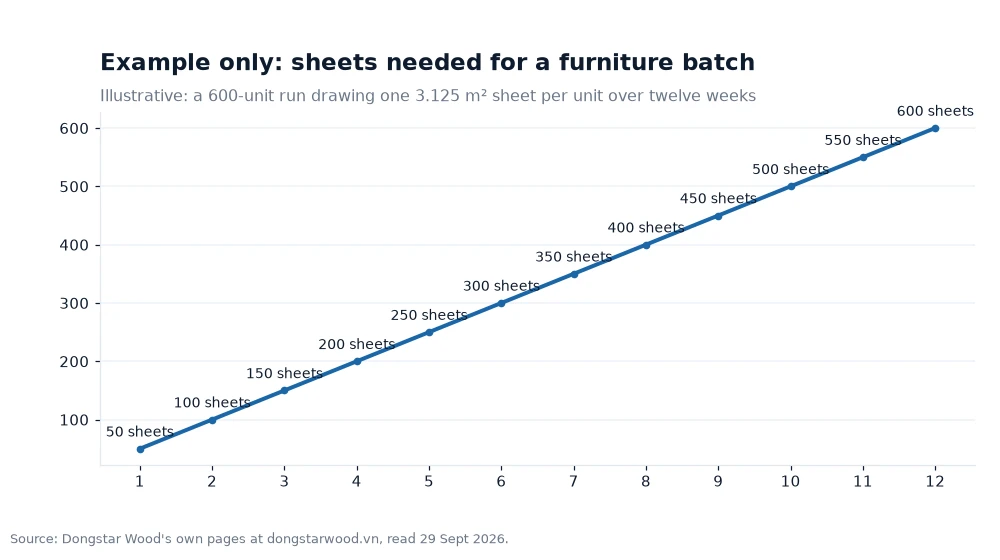
Worked example: 600 sheets over twelve weeks
Take a finishing line running 50 sheets a week for twelve weeks: 50 × 12 = 600 sheets in the programme. Each 1250 × 2500 mm sheet measures 1.25 × 2.5 = 3.125 m², so the weekly throughput is 50 × 3.125 = 156.25 m² of panel, or 156.25 ÷ 5 = 31.25 m² per working day.
Count the faces instead of the panels and the volume doubles: a sheet finished on both sides carries 2 × 3.125 = 6.25 m² of veneer surface, so the full run puts 600 × 6.25 = 3,750 m² of face through the booth. That is the number a spray shop needs for booth time and drying space, and it comes straight off the published sheet size rather than a supplier's estimate.
Emissions paperwork for interior panels
A finished interior panel carries two specifications into a building: what the face looks like and what the panel emits. The published compliance options for this range are E1, CARB P2 plus CE documentation, as standard with low-emission glue systems used in pressing. For a furniture programme selling into markets that ask for those documents, ordering them with the panels is simpler than chasing them afterwards.
Moisture performance can be specified alongside them, since phenolic or melamine adhesive systems are published as options where a panel needs more resistance than a dry interior requires. Practical finishing follows the same principle: store panels flat and dry before the booth, seal the edges with the same care as the face, and the finish will hold through the building's first heating season.
Frequently asked questions
Does a birch face take stain evenly?
Its published face is a uniform birch veneer in light cream to pale brown, described as suitable for staining, and uniformity is what makes an even result possible. The variable is preparation rather than the panel: patches, filled knots and inconsistent sanding absorb stain at different rates, so those areas are what to check before a clear or stained finish is committed.
Can laminated and painted panels come from the same order?
Yes. Both routes are named among the intended uses, and the compliance documents behind them — E1, CARB P2 and CE documentation, with low-emission glue systems — apply to the panel rather than to the finish. Keeping one order means one batch of faces, which is what stops a laminated carcass and a painted shelf disagreeing about colour in the same room.
Which thickness suits a panel that will be laminated?
Thickness from 2.7 mm to 30 mm is published for this range, with custom sizes available and standard formats at 1500 × 3000 mm alongside 1220 × 2440 mm and 1250 × 2500 mm across the range. Thin panels work for facings and panelling, while thicker sheets carry the machining and edge detailing that laminate work leans on for a clean finish.
Where to check the specification before ordering
The cut list usually decides the next step. Where the finished panels are part of a carcass programme, the commercial panel range sets out thickness bands for backs, shelves and worktops in one view. And if the question is whether the same specification can be repeated across a year of deliveries, the plant's own page collects capacity, storage and the certification list together.
Face, thickness and compliance details: the factory's own website, consulted on 29 Sept 2026 and used in this briefing and used in this briefing[1].