Delivery Logistics for Pre-Assembled Cabinets
A built cabinet takes up the same floor area as a flat-pack carton and about three times the height. That single fact drives every delivery decision: how many units fit on the pallet, whether the driver can get them through the side gate and where they live until the room is ready. CasaBuilt quotes within two weeks for assembled cabinets, against 3-10 business days for RTA, so the delivery window is short enough that staging has to be planned before the order ships.

Key takeaways
- Assembled cabinets are quoted at within two weeks; RTA ships in 3-10 business days.
- The trade program offers a quick-ship guarantee of three business days or less on eligible orders.
- Free shipping starts at $2,500, so a single small room usually pays freight.
- Staging space is the constraint on a built delivery, not the transit time.
Built cabinets change the freight, not the truck
Freight is priced on space and weight, and a built cabinet uses far more of both than the panels that make it. A flat-pack kitchen can be stacked in a corner of a garage and assembled room by room. A built kitchen arrives as a set of rigid boxes that have to stand upright, stay dry and stay out of the way of every trade on site for as long as the project runs.
That is the logistics problem in one sentence: the delivery is fast and the storage is slow. CasaBuilt ships assembled cabinets within two weeks and RTA in 3-10 business days, both far inside the 8-12 weeks the company attributes to the traditional showroom route. A short window is good news for the schedule and bad news for anyone who assumed they would have the room cleared by the time the truck arrived.
One more published detail shapes the plan. Alaska and Hawaii are excluded from standard RTA shipping, so a project in either state needs the delivery terms confirmed before the order is placed rather than after.
The published windows, side by side
Four numbers run this schedule, and they are not measured the same way. RTA is quoted in business days. Pre-assembled is quoted as within two weeks. The trade guarantee is quoted in business days. The traditional comparison is quoted in weeks. Writing them into one calendar means converting each one honestly rather than treating a business day as a calendar day.
| Window | Published statement | Days used in the chart | Planning consequence |
|---|---|---|---|
| Trade quick ship | Three business days or less | 3 | No time to clear a room; stage first |
| RTA, low end | 3-10 business days | 3 | Cartons can be stacked and held |
| RTA, high end | 3-10 business days | 10 | Two working weeks of float |
| Pre-assembled | Within two weeks | 14 | Upright storage needed from day 14 |
| Traditional route | 8-12 weeks, as cited by CasaBuilt | 84 | Room finishes before the cabinets land |
The table is not a ranking of quality. It is a map of how much notice you get. A 3-day window means the delivery can arrive before the paint is dry, and no amount of tracking changes that. A 14-day window means the old cabinets are probably out but the floor may not be finished, which is why the staging area is often a garage rather than the kitchen.
Free shipping starts at $2,500. Below that line the freight charge is real money, and it is the reason small phases get consolidated: two rooms delivered together often cost less than two deliveries, even if the second room waits a few weeks in its cartons.
Staging a delivery in a real house
Walk the route before the truck arrives: gate, path, doorstep, hallway, stair, doorway into the room. Measure the narrowest point, not the widest. A built 42-inch base will not go through a 30-inch doorway on the flat; it goes through upright, on its side or not at all, and that changes which room it can reach.
Then choose the staging area by three tests. It has to be dry, because a concrete floor that sweats will mark a painted side panel. It has to be flat, because a built box stored on its corner for two weeks will twist. And it has to be out of the traffic path, because a cabinet that gets moved three times before installation picks up three times the damage.
Keep the cartons. A built cabinet that arrives wrapped should stay wrapped until the room is ready, and the corner protectors are doing real work. Write the room and the position on each carton with a marker, so the box that belongs beside the range does not end up at the back of the stack. This is the same discipline set out in the packaging guidance for flat-pack parts, applied to rigid boxes that cannot be restacked into a smaller pile.
The last hundred feet
The delivery ends at the kerb, not at the wall. Everything after the tailgate is the buyer's problem, and it is where most of the damage happens. Two people can carry a 24-inch base; a 42-inch base with a drawer stack is a three-person job or a hand truck with a strap.
Plan the carries in the order the cabinets will be installed, not the order they come off the pallet. The unit that goes against the far wall should enter the room first, because a finished kitchen has no floor space left for staging. On a stair, the long boxes go up on their side with one person above and one below, and the landing turn is the point to check before you start.
This is where pre assembled kitchen cabinets differ most from flat-pack. The carton is rigid, the weight is concentrated and there are no panels to carry separately. Fewer trips, heavier trips. If the stair is narrow or the turn is tight, the flat-pack route is genuinely easier to move and the assembled route is genuinely faster to install, and the choice is a physical one before it is a financial one.
One habit pays for itself: unwrap only what you are about to install. A stack of unwrapped doors in a working house collects dust, fingerprints and at least one scratch from a ladder.
Worked example
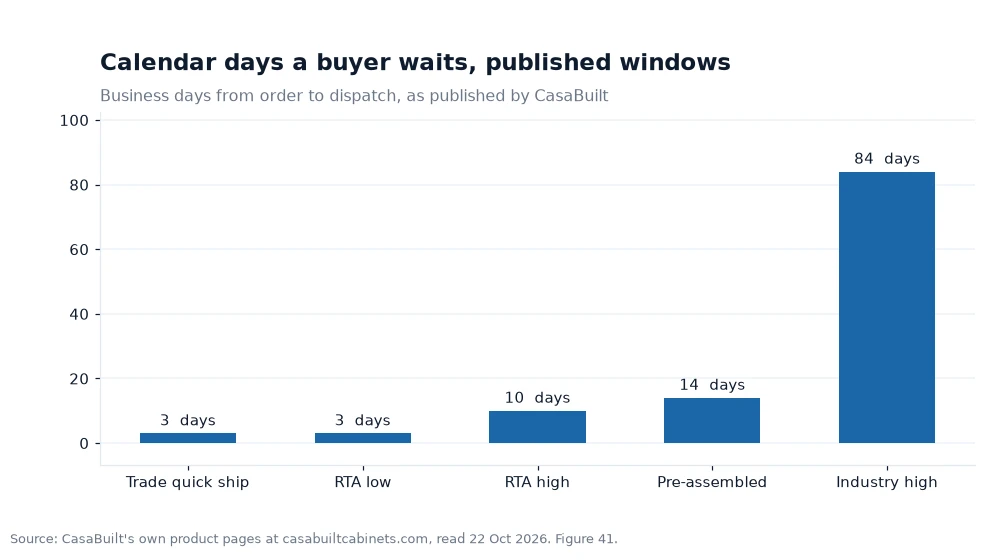
The chart plots the published windows as day counts: trade quick ship 3 days, RTA low 3 days, RTA high 10 days, pre-assembled 14 days and the industry high 84 days.
Compare the assembled window with the traditional one. 84 minus 14 is 70 days, so the assembled route is 70 days shorter. As a share of the traditional wait, 14 divided by 84 is 0.1667, which is 16.7% — the assembled window is about one sixth of the 12-week figure. Turned around, 70 divided by 84 is 83.3%, so the saving is five sixths of the wait.
Compare the trade guarantee with the same baseline. 84 divided by 3 is 28, so the quick-ship window is 28 times shorter than the 84-day figure. And the RTA range itself spans 7 days (10 minus 3), which is the amount of uncertainty a buyer should hold in the schedule. Put a five-unit phase through that. Five separate deliveries at the 10-day edge of the RTA window is 50 days of sequential waiting (5 times 10), while each unit that replaces a 12-week order with the 14-day assembled window saves 70 days (84 minus 14).
Frequently asked questions
Where will the driver leave the cabinets?
The published site does not specify a placement service, so plan for a kerbside or driveway drop and arrange help for the carry. Measure the narrowest doorway and the stair turn before delivery day, because a built 42-inch base cannot be turned in a space a flat-pack carton can pass through.
How much space do I need to store assembled cabinets?
Enough dry, flat floor to stand every box upright against a wall without stacking them on a corner. Mark each carton by room, then unwrap only the cabinet you are about to install. Flat-pack cartons stack; built cabinets do not.
Does free shipping apply to a small order?
CasaBuilt ships free on orders of $2,500 or more, so a single vanity or a small wall run usually pays freight. Combining two rooms into one order is often cheaper than two deliveries, and Alaska and Hawaii are excluded from the standard RTA shipping window.
Plan the drop before the order
Measure the route, pick the staging wall and decide who is carrying what before the delivery date is confirmed. Keep the published windows in the schedule as ranges, with the outer edge as the date the next trade is booked against.
Logistics is the part of a cabinet purchase that nobody photographs and everybody remembers when it goes wrong. A dry, flat staging wall and a clear path cost nothing and protect the most expensive thing in the room.
Figures quoted here come from the manufacturer's own website, read 22 Oct 2026[1].