How Does a Period Underwear Manufacturer Support New Product Development?
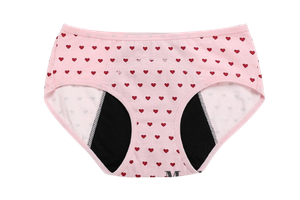
A period underwear manufacturer supports product development by turning a design brief into measurable fabric, gusset, fit, wash, and production specifications. Development normally covers 3–5 functional layers, several prototype rounds, size grading, absorbency testing, leakage checks, and repeated laundering. ISO 6330:2021 alone provides 35 washing procedures across three machine types and six drying procedures for textile evaluation. A manufacturer can also compare absorbent materials, waterproof membranes, seam methods, and garment constructions before bulk production. The purpose is to prove performance, fit, durability, and manufacturing consistency before thousands of units are cut and sewn.
Product development usually starts with numbers rather than sketches. A brand may specify a target retail market, size range, garment style, intended flow level, fabric hand feel, and expected use. The factory then converts those requirements into measurements: fabric weight in g/m², elastane percentage, gusset length, gusset width, finished garment measurements, seam allowance, elastic tension, and acceptable dimensional tolerance.
A typical period brief may combine 3 or 4 functional materials: a skin-contact layer, an acquisition or distribution layer, an absorbent layer, and a waterproof barrier. Adding another layer may raise fluid capacity, but it also increases thickness and drying time. Development therefore compares combinations rather than automatically adding fabric.
A useful specification does not say “high absorbency.” It states the test method, sample condition, liquid quantity, acceptance level, wash history, and where leakage is considered a failure.
Material development follows because the underwear body and absorbent gusset behave differently during use. The body fabric must stretch with the wearer and recover after removal, while the gusset needs enough structural stability to keep several layers aligned. A fabric containing 5–15% elastane, for example, can behave very differently from a similar-looking fabric with lower stretch content, so percentage alone cannot replace physical testing.
The manufacturer can screen fabrics for weight, stretch, recovery, shrinkage, moisture handling, pilling, colorfastness, and dimensional stability. AATCC maintains separate textile methods for properties including absorbency, pH, abrasion, water behavior, laundering, and seam appearance rather than treating textile “quality” as one measurement.
That screening narrows the material options before the gusset is engineered. One collection might use a lighter construction for spotting or backup protection and a longer, thicker configuration for overnight wear. The outside silhouette can stay almost identical while the internal layers, waterproof coverage, or rear extension change.
| Development variable | What the manufacturer can measure | Why brands need the data |
|---|---|---|
| Body fabric | g/m², fiber %, stretch and recovery | Controls fit and garment feel |
| Gusset | width, length, layer count | Controls coverage area |
| Absorbent material | uptake rate and retained liquid | Supports performance claims |
| Barrier layer | water-penetration resistance | Checks leakage protection |
| Finished garment | measurement tolerance and shrinkage | Supports repeatable sizing |
| Washing | 5, 20, 30 or more agreed cycles | Checks performance after reuse |
Waterproof performance deserves separate testing because a membrane that stops penetration when new may behave differently after repeated washing, stretching, stitching, or bonding. ISO 811:2018 specifies a hydrostatic-pressure method for measuring fabric resistance to water penetration, and the standard was reviewed and confirmed as current in 2025.
The test result still needs to be considered together with garment construction. Needle holes, uncovered edges, narrow gussets, uneven layer placement, or poorly positioned seams can allow fluid to move beyond the protected area even when the membrane itself performs well.
Leak protection is therefore a garment-level engineering issue, not only a membrane specification.
Fit development starts once the first functional construction is available. Using a normal underwear pattern and inserting several layers can change stretch, thickness, leg opening tension, and how closely the gusset sits against the body. A manufacturer may modify front rise, back rise, crotch width, leg curve, waistband length, and gusset position across 2–4 prototype rounds before approving the base size.
Grading then needs separate attention. Increasing every measurement by the same percentage can move the absorbent area away from the intended position. A range covering XS to 3XL may need six or seven size points, and larger sizes may need revised gusset width or coverage rather than a simple proportional enlargement.
Sampling provides the physical data needed to make those changes. A commercial program may move through a first prototype, revised fit sample, size set, material-confirmation sample, and pre-production sample. Five sample stages do not guarantee a better product; each stage needs a defined question and recorded measurements.
For example:
-
Prototype 1 can check whether the 4-layer gusset sits correctly.
-
Prototype 2 can compare two absorbent constructions.
-
A size set can check 3–7 graded sizes.
-
A wash sample can compare measurements before and after laundering.
-
A pre-production sample can confirm the actual bulk fabrics, trims, stitching, labels, and packaging.
Repeated laundering becomes especially important because period underwear is sold as a reusable garment. ISO 6330:2021 contains 16 procedures for Type A machines, 12 for Type B, and 7 for Type C, plus six drying procedures. The standard also notes that washer type, detergent, and drying conditions can affect results.
A brand and manufacturer should therefore agree on the wash protocol before comparing samples. Washing one sample 30 times under one procedure and another 30 times under a different procedure creates data that are difficult to compare.
Color and surface appearance also need separate controls. AATCC TM61 uses accelerated laundering to assess textile colorfastness; one 45-minute test under specified conditions can approximately represent the color change associated with five typical hand or home launderings. That can help screen dark, bright, printed, or contrast-colored fabrics during development before longer garment-wash programs are completed.
Absorbency needs equally specific wording. Comparing period underwear only by “milliliters absorbed” can give an incomplete picture because capacity, intake speed, liquid distribution, surface wetness, and leakage are different properties. A sample that holds a large quantity after slow laboratory saturation may still perform poorly when liquid reaches one small area quickly.
A capable period underwear manufacturer can build an internal development protocol around repeated sample conditions. For example, three specimens from each construction can be tested before washing and another three after an agreed number of cycles. Using n=3 does not establish universal product performance, but it gives development teams more information than relying on one specimen.
The same approach applies to seams. The factory can compare stitched, bonded, flatlock, enclosed-edge, or hybrid constructions according to garment style. Seam choice affects thickness, stretch, production speed, appearance under clothing, and the number of needle penetrations around protected areas.
Manufacturing time also enters the product specification. A gusset that requires nine separate positioning and sewing operations may produce acceptable samples but become difficult to hold within tolerance on a larger order. Reducing the sequence to six repeatable operations can sometimes improve line consistency without changing the consumer-facing design.
Material consumption is another part of development. Extending a waterproof panel by 20% may improve coverage, but the pattern change can also alter marker efficiency and material use per garment. A factory can calculate consumption from actual marker layouts rather than estimating cost from the sample alone.
Cost work should separate functional components from cosmetic ones. If a brand has a fixed factory-price range, the manufacturer can compare body fabrics, trims, waistband constructions, print methods, gusset materials, and packaging while preserving the agreed performance specification. Removing one decorative operation may be preferable to reducing absorbent material without retesting.
Production readiness then depends on documentation. Before bulk cutting begins, the approved product can be recorded through a bill of materials, graded measurement chart, construction sheet, artwork files, stitch instructions, material references, labeling details, packing instructions, test requirements, and approved pre-production sample.
Measurement tolerances should be stated numerically. A waistband measurement might permit a defined ± tolerance, while gusset position may require a tighter limit because movement of even 10–15 mm can affect coverage. The allowable figure should come from the actual pattern, fabric behavior, production process, and brand specification rather than one universal tolerance.
Quality planning can also use sample-based inspection rather than checking only finished cartons. Incoming fabric can be checked before cutting; absorbent components can be verified during preparation; gusset placement can be inspected during sewing; measurements and workmanship can be checked after assembly. Finding a placement problem after 200 units is materially different from discovering it after 20,000 units.
A period underwear manufacturer with product-development capability can also maintain approved material references between sampling and production. This matters when two fabrics share the same fiber composition but differ in knitting structure, finishing, weight, stretch, or supplier lot. “95% cotton, 5% elastane” alone is not enough to reproduce the fabric used in an approved sample.
Supplier documentation also matters when the product is sold through established retail channels. Fiber composition, care instructions, chemical compliance, material certificates, test reports, and traceability records may need to be collected before shipment. Requirements differ between the United States, the European Union, the United Kingdom, Australia, and individual retailers, so intended sales markets should be known during development rather than after production.
Product claims require similar discipline. Terms such as “leakproof,” “absorbs X mL,” or “lasts X hours” should be connected to a defined test setup and appropriate supporting data. A claim based on three laboratory specimens under controlled conditions should not be presented as if every wearer, flow pattern, size, and activity will produce an identical result.
By the pre-production stage, the manufacturer should be able to compare the approved sample with production materials under the same agreed conditions. If 30-cycle laundering, dimensional checks, water-penetration testing, and absorbency checks were used during development, changing the method after bulk production prevents a clean comparison.
That continuity is where a period underwear manufacturer contributes most to new product development: material specifications, sample measurements, wash conditions, functional tests, size grading, sewing methods, cost data, and inspection requirements remain connected from the first prototype through commercial production. A product approved after 3–5 structured sample rounds with recorded measurements gives the production team a measurable reference rather than a collection of subjective comments.