How a Perfume MOQ Gets Set: Six Steps From Brief to Purchase Order
A minimum order quantity is not quoted, it is constructed. It falls out of six decisions — the pack, the fill, the standardisation choices, the pricing points, the specification and the payment terms — and each one narrows what the next can be. Buyers who understand the order of those decisions usually end up with a number they chose rather than a number they were given.
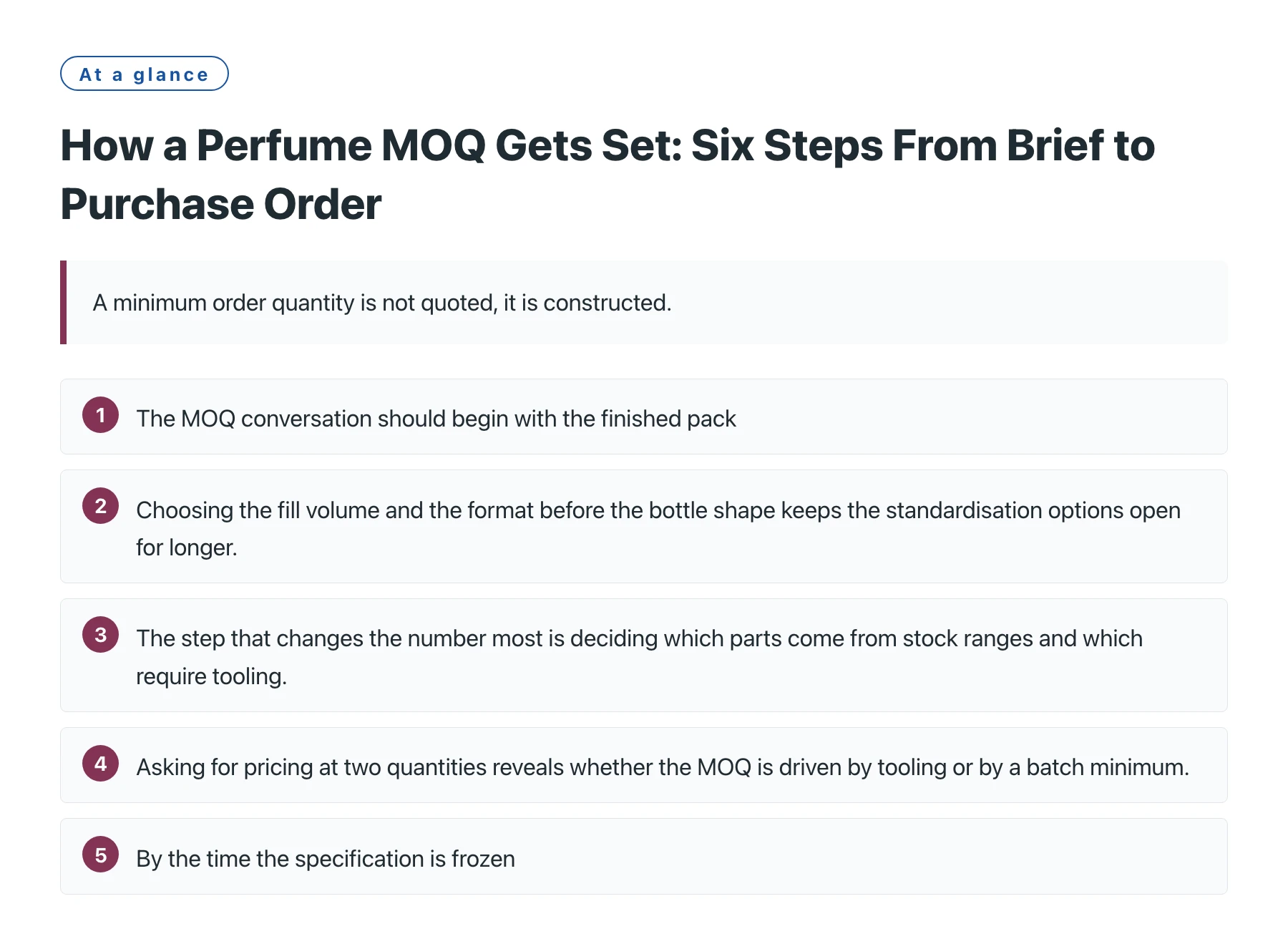
Key takeawaysThe MOQ conversation should begin with the finished pack, because the pack determines which component minimums apply. · Choosing the fill volume and the format before the bottle shape keeps the standardisation options open for longer. · The step that changes the number most is deciding which parts come from stock ranges and which require tooling. · Asking for pricing at two quantities reveals whether the MOQ is driven by tooling or by a batch minimum. · By the time the specification is frozen, the order quantity is already determined; negotiating it afterwards rarely works.
This is written from the perspective of a product developer running a set project for the first time, because that is where the sequence matters most. Experienced buyers do these six steps almost automatically, and the reason they look calm in supplier meetings is that they never let step four happen before step two.
The steps are sequential in practice, even though a good supplier will work on several in parallel. What matters is not to fix a quantity before the pack is defined, and not to define the pack before you know which parts are available without tooling.
Each step below notes what gets fixed and what stays open, because the freedom you still have is the only real negotiating position.
The six steps, in the order that works
Read this as a sequence of narrowing choices. At the start almost everything is open; by the end, only the delivery date is. The MOQ is set somewhere in the middle, in step four, and by then the buyer has already made most of the decisions that determine it.
Step one: define the finished pack, not the scent
The first useful document is not a fragrance brief. It is a description of what the customer will hold: how many units in the set, what each unit is, whether there is a box, what the box is made of, and roughly what it should retail for. This is the document that lets a supplier say early whether the idea is feasible at the price the buyer has in mind.
Starting with the scent instead is the most common reason a project loops back. The fragrance is the part that can be adjusted most freely in the early stages; the pack is not.
Step two: choose the format and the fill volume
Travel sprays, rollerballs, miniatures and full-size bottles each map to a different range of stock containers. Choosing a common fill volume — 10 ml, 30 ml, 50 ml — keeps the container options in existing moulds and postpones the one decision that raises the MOQ permanently. A first set is often better served by one well-chosen format than by three clever ones.
This is also the step where the set concept gets tested against reality. If the concept needs three formats, the supplier should say so now, while the box and the artwork can still absorb the change.
Step three: mark what is standard and what must be bespoke
Go through every component and mark it stock or custom: glass, cap, pump, label, print, box, insert, carton. This single list is the strongest lever available to a buyer, because every item moved from custom to stock removes a tooling line and lowers the volume floor. A manufacturer that supports both OEM and ODM work is used to this review, because fragrance OEM/ODM production partner arrangements start by sorting the components exactly this way.
The instinct to make the bottle distinctive is understandable and sometimes correct. It just needs to be a decision with a cost attached, taken in full view of the alternative.
Step four: ask for two prices, not one
With the pack defined and the standardisation decisions made, the supplier can price the project at a minimum quantity and at a larger one. The two numbers together reveal what kind of floor you are standing on. If the price per unit falls steeply, tooling and set-up dominate and a larger first order is genuinely worthwhile. If it barely moves, the floor is a batch minimum or a labour constraint, and ordering more buys very little.
This is the step where the MOQ is effectively set. Everything after it is confirmation.
Step five: freeze the specification, including the regulatory details
The specification is the document the factory will produce against: formula reference, concentration, fill weight and tolerance, decoration references, labelling content and pack description. Concentration matters for more than performance, because limits on fragrance materials are set by product category and a percentage that is acceptable in one application is not automatically acceptable in another [1].
Freezing the specification is not the same as freezing the artwork. Decoration and label files can usually be finalised later, as long as the physical references — bottle, cap, box, insert — are locked, because those are the items that carry lead times and tooling.
Step six: confirm quantity, deposit and schedule
Only now is the order quantity formally agreed, together with the deposit, the tooling payment if any, the balance terms and the delivery window. Ask for the schedule to be expressed against component lead times rather than as a single date, so it is clear what would actually delay the run.
It is worth stating the obvious here: a quantity agreed at this point is a quantity the line can be scheduled for. Changing it afterwards, especially downward, is the change that factories handle least gracefully.
What is fixed at each step, and what is still open
| Step | What becomes fixed | What is still open |
|---|---|---|
| Pack concept | Market, number of units, box construction, target retail price | Bottle shape, decoration method, artwork |
| Format and fill | Container family and fill volumes | Decoration, closure finish |
| Standard or bespoke | Which components come from stock ranges | Final order quantity, colour of the print |
| Two-point pricing | Cost lines and how they behave with volume | Which quantity to commit to |
| Specification freeze | Formula, concentration, fill tolerance, labelling content | Artwork final files, if the physical pack is locked |
| Order and deposit | Quantity the factory will schedule, payment schedule | Delivery date, subject to component lead times |
The last two rows are the ones buyers try to reopen. In practice the only rows still movable at that stage are artwork and delivery date.
If a supplier will not discuss the pack before quoting a quantity, the conversation is running backwards. Ask for the component list first and the quantity second. That single change in order turns a negotiation about price into a short technical conversation about which parts exist and which do not.
What usually goes wrong in the sequence
The failures are consistent. A buyer fixes a quantity with a sales contact, then discovers that the box requires tooling at a much higher volume. Or the scent is approved, then the bottle changes and the artwork has to be redone. Or the market is added late, and the label has to carry information that does not fit the space allowed for it.
Each of those is a sequencing error rather than a supplier failure. The remedy is the same in all three cases: get the full component list and the destination market onto one page before the quantity is discussed at all.
Where the supplier makes the sequence easier, it is usually because the process is documented. A manufacturer that publishes its development and production steps — the same way what one-stop scent development covers does on a service page — gives a buyer a checklist to work against, and checklists are what stop sequencing errors.
Where to start if the project is already underway
If you want to see the whole sequence described end to end before you start, the service pages at www.xuelei.com/ set out how a project moves from brief to filling, which is useful mainly as a template for the questions you should be asking your own shortlist.
For a project that has already begun, the repair is usually the same in each case: write the component list and the destination market on one page, compare it against what has been fixed so far, and identify the earliest decision that was taken out of order. Fixing that one decision is normally enough to bring the quantity back into a range the order can support.
Sources
- IFRA Standards Library (International Fragrance Association) —— The IFRA Standards Library lists the restrictions the fragrance industry applies to individual fragrance ingredients, based on safety assessments; it is the reference point for compliant fragrance formulation.
Frequently asked questions
Can the MOQ be negotiated downwards?
Sometimes, but only by changing the pack rather than by asking. Moving a component to stock, simplifying the decoration or sharing a concentrate across variants each lowers a real minimum. Asking for a lower number with the same pack usually produces a lower quality of answer rather than a lower quantity.
At which step should I involve the factory?
At step one. A supplier who sees the whole concept can tell you which parts are available without tooling before you have designed around a bottle that does not exist. Bringing them in at step four means paying for revisions.
How long does this sequence take?
The decisions are usually quick; the sampling is not. If the pack uses standard components, the sequence from brief to a firm quote can be a matter of weeks. If new tooling is involved, the mould work sits on the critical path before anything else can be scheduled.
Does a bigger first order always reduce the unit price?
It reduces it, but not always meaningfully. If the two-point pricing shows a shallow curve, the floor is a batch or labour minimum rather than tooling, and ordering more changes little. That is the point of asking at two quantities rather than one.
What if the market requirements are not known yet?
Then the specification cannot be frozen, and the safest path is to design a label with room to spare and to keep the number of SKUs low until the markets are confirmed. Adding a market later is cheaper than reprinting a whole run.